LLM, RAG, Embeddings, Agentic AI, and Orchestrators: understanding the key concepts of generative AI

Artificial Intelligence has its own language. And it's evolving fast.
LLMs, RAG, Embeddings, Agentic AI, Orchestrators… These terms are now ubiquitous in discussions surrounding artificial intelligence.LLM, RAG, Embeddings, Agentic AI, Orchestrators… These terms are now ubiquitous in discussions about artificial intelligence.
Yet, behind these sometimes intimidating acronyms lie essential concepts for understanding how the generative artificial intelligence solutions that are transforming businesses today work. LLMs, embeddings, RAG, AI agents, and orchestrators now form the fundamental building blocks of modern AI architectures deployed across many sectors.However, behind these sometimes intimidating acronyms lie essential concepts for understanding how generative artificial intelligence solutions, which are transforming businesses today, work. LLMs, embeddings, RAG, AI agents, and orchestrators now form the fundamental building blocks of modern AI architectures deployed across many sectors.
In this article, we break down five essential concepts that form the foundation of modern artificial intelligence architectures today.In this article, we demystify five essential concepts that today form the foundation of modern artificial intelligence architectures.
1. LLM (Large Language Model)
Since the arrival of ChatGPT, the term LLM (Large Language Model) has become central to all discussions about AI.
The principle is relatively simple: to enable a machine to understand and generate human language fluently and coherently. To achieve this, these models are trained on massive volumes of texts — books, articles, and specialized documents — which allows them to identify language structures and reproduce complex reasoning.
Specifically, an LLM can answer questions, write content, translate, generate code, or summarize information.
Today, it is the central building block for almost all AI assistants and generative AI applications in businesses. Whether for document assistance, data analysis, or process automation, the LLM typically serves as the conversational engine of the system. Its strength lies in understanding natural language. Its limitation, however, is clear: it doesn't know your company. This is precisely where the other components come into play.
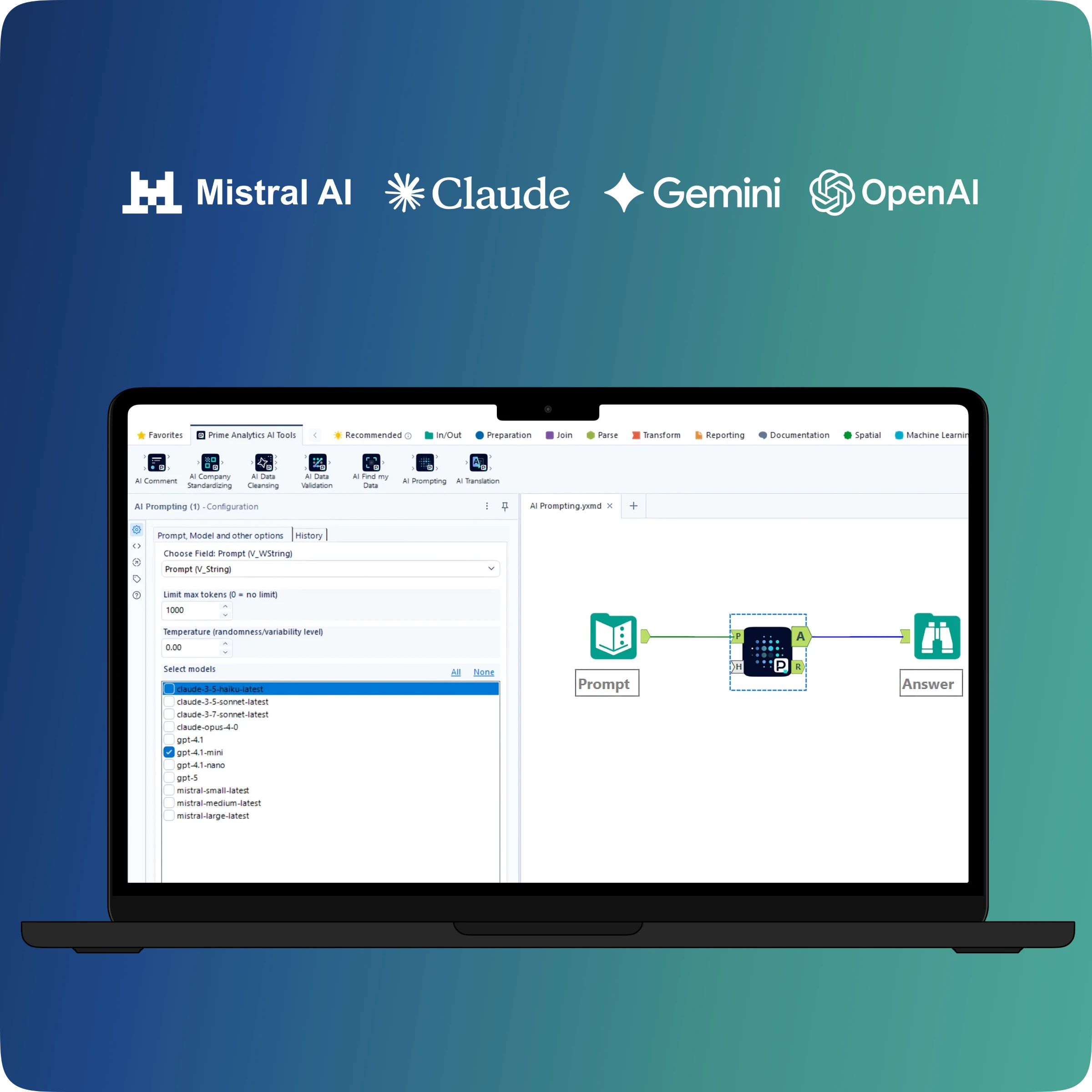
Among the most well-known LLMs are OpenAI's GPT (which powers ChatGPT), Anthropic's Claude, Google's Gemini, as well as Mistral Large and Llama. Although developed by different organizations, these models share a common goal: to understand and generate natural language to assist users with a wide variety of tasks.

2. Embeddings
To effectively leverage a company's knowledge, an AI must first be able to understand what it receives. However, models don't process documents like we do; they work with mathematical representations.
This is precisely the role of embeddings.
They transform content (text, image, audio, or document) into a numerical vector representing its semantic meaning. What makes this approach particularly useful is that it captures the meaning of information, not just its words.
Two documents written differently but addressing the same topic will be identified as similar. In a professional environment where information is scattered across multiple sources, this capability becomes a real asset for organizing, searching, and leveraging existing knowledge. Embeddings play a particularly key role in building knowledge bases that can be utilized by generative AI systems, by facilitating semantic search and the identification of the most relevant information.

3. RAG (Retrieval-Augmented Generation)
LLMs are powerful, but they have a significant limitation: they don't know your organization's specific information. Internal procedures, activity reports, business data – none of this is part of their initial training.
RAG, or Retrieval-Augmented Generation, is currently one of the most widely used AI architectures for connecting a language model to an organization's specific knowledge.
Its principle is simple: before generating a response, the system identifies the most relevant information in your own documents and transmits it to the LLM to enrich its context.
AI combines its general knowledge with information retrieved from your documentation base to produce a contextualized response. A bank advisor who queries the assistant about a compliance procedure will thus receive an answer drawn directly from their institution's internal documentation, rather than a generic response.
Result: more precise, up-to-date answers, rooted in the reality of your organization and less exposed to the risks of hallucination – those incorrect responses that models can produce when they lack reliable information.
This approach also makes it possible to leverage up-to-date information without requiring model retraining.

4. Agentic AI / Agentic AI
The first generations of generative artificial intelligence demonstrated their ability to understand questions and produce quality answers. But in a professional context, simply answering a request is not always enough: it is also necessary to be able to act.
This is precisely the ambition of Agentic AI, an approach that aims to develop AI agents capable not only of understanding a request, but also of making decisions and acting to achieve an objective.
An agentic system represents a new generation of AI architectures capable not only of understanding a request, but also of reasoning, planning, and acting with limited human intervention.
To achieve this, this approach relies on one or more agents capable of planning, reasoning, and executing actions across various tools. In the most advanced architectures, several specialized agents can collaborate to search for information, analyze data, perform calculations, or interact with business applications. These agents work together and are coordinated by an orchestrator to accomplish an end-to-end mission.
Unlike traditional models that are limited to producing a response, Agentic AI demonstrates autonomy, adaptability, and a true results-orientation. Where an LLM can explain how to perform a task, an agentic system can execute it itself.
For example, a user can request the preparation of a sales report.
Agentic AI will then be able to collect data, perform analyses, generate a summary, and automatically produce the final deliverable.
Agentic AI thus paves the way for a new generation of intelligent systems capable not only of understanding requests, but also of transforming them into concrete, value-creating actions.

5. Orchestrator
In businesses, these different building blocks are rarely used in isolation. The most effective enterprise generative AI solutions are those where, as AI architectures become more sophisticated, multiple AI agents, models, knowledge bases, and specialized tools must collaborate to effectively respond to a single request.
It is in this context that the Orchestrator comes into play, a software component responsible for coordinating the entire system. Sometimes called a Supervisor, it acts as a control layer that interprets the user's stated objective and then mobilizes the various agents and tools necessary for its achievement.
Its role is to determine which resources should be called upon, in what order they should intervene, and how information should be transmitted from one stage to the next. It analyzes the request, distributes tasks among specialized components, and ensures that their results are properly utilized to produce a coherent response.
The Orchestrator can be compared to a conductor leading several musicians or a project manager coordinating different expert teams. The Orchestrator generally does not perform operational tasks itself, but ensures that each component contributes effectively to achieving the final objective.
generally combine an LLM, embeddings, a knowledge base, a RAG mechanism and, increasingly, AI agents coordinated by an orchestrator.
Understanding their respective roles helps to better grasp the AI architectures that are currently transforming professional practices.
While these concepts currently form the basis of generative AI vocabulary, they represent only a part of a constantly evolving landscape.
New concepts are already emerging, from Context Engineering to Model Context Protocol, including Sovereign AI, Reasoning Models, and agents capable of interacting directly with their digital environment.
At Prime Analytics, we assist organizations in designing and deploying solutions that combine generative AI, RAG, AI agents, and data governance. In our upcoming articles, we will delve into the emerging concepts that are already shaping tomorrow's architectures.

An expanding AI glossary
In businesses, these different building blocks are rarely used in isolation. The most effective enterprise generative AI solutions typically combine an LLM, embeddings, a knowledge base, a RAG mechanism, and increasingly, AI agents coordinated by an orchestrator.
Understanding their respective roles provides a better grasp of the AI architectures that are currently transforming professional practices.
While these concepts currently form the foundation of generative AI vocabulary, they represent only a fraction of a constantly evolving landscape.
New concepts are already emerging, from Context Engineering to Model Context Protocol, including Sovereign AI, Reasoning Models, and agents capable of directly interacting with their digital environment.
At Prime Analytics, we assist organizations in designing and deploying solutions that combine generative AI, RAG, AI agents, and data governance. In our upcoming articles, we will delve into the emerging concepts that are already shaping tomorrow's architectures.


We will get back to you as soon as possible.
Please try again or contact us at contact@primeanalytics.fr.